
Abby Cook
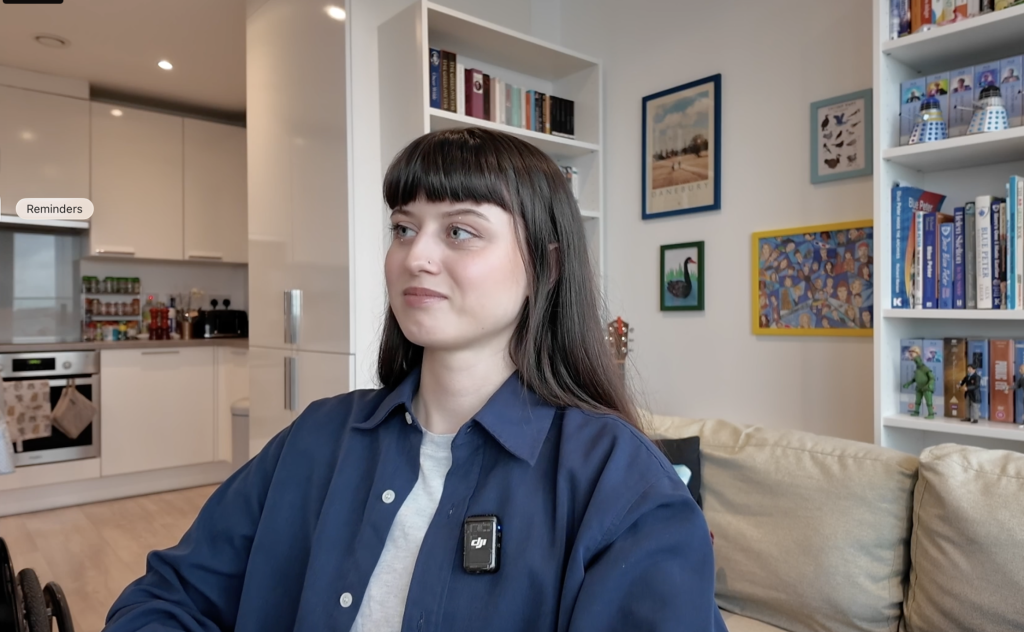
Interview date(s): 23 February 2026
Interviewer(s):
Camera: Andy Murray
Production Media: video
- Abby Cook, born in Falkirk, Scotland, studied applied biological science and biomedical science before leaving university when inaccessible accommodation and pandemic-era study made the course impractical.
- She later studied occupational therapy and worked in disability sport, coaching and tutoring. Through work with Scottish Disability Sport and the Scottish Association for Mental Health, she developed confidence in public speaking and television appearances.
- After being contacted through Instagram in August 2022, she completed auditions and screen tests, and was offered a presenting role on Blue Peter in November 2022. She began the following February or March and moved to Salford.
- Abby describes the role as varied, involving challenges, studio segments and visits, and valued learning from production crews. She highlighted the transition from being nervous on camera to enjoying presenting.
- She has also presented or appeared on other programmes and events, including Celebrity Mastermind, Morning Live, BBC Live Lessons, the London Marathon and live stage events.
- She is interested in trying radio and, in the longer term, potentially training as a multicamera studio director. She has no fixed career plan and is keen to explore new opportunities.
- Abby has Ehlers-Danlos syndrome and postural orthostatic tachycardia syndrome, among other conditions, and uses a wheelchair. She is the first visibly disabled presenter on Blue Peter.
- Wheelchair racing helped her feel accepted as a disabled person and changed how she understood disability, including the role of environmental barriers. She helped develop the “Disability Identity and Me” workshop with Scottish Disability Sport and the Scottish Association for Mental Health.
- She describes the value of featuring disability sports on children’s television and said that access coordinators help productions meet varied access requirements.
This transcript has been produced automatically using Otter, https://get.otter.ai/interview-transcription/.
It provides a basic, but unverified or proofread transcript of the interview. Therefore, the British Entertainment History Project (BEHP) accepts no liability for any misinterpretation of the content of this interview.
However, the BEHP wants to make every effort to improve the quality of these transcripts and would welcome any voluntary offers to proofread this and/or other interviews. If you want to help, please contact BEHP Secretary, sue.malden@btinternet.com
Abby Cook Transcript
Andy Murray 00:00
Can I just check that you're okay with this being uploaded and used for The British Entertainment History Project?
Abby Cook 00:05
I am absolutely okay with it being uploaded and used by The British Entertainment History Project. Yeah.
Andy Murray 00:15
Can I ask your name?
Abby Cook 00:16
Yes, my name is Abby Cook.
Andy Murray 00:18
And your date of birth?
Abby Cook 00:19
25th of August 2002.
Andy Murray 00:22
Your specialist subject? That's a joke, but we'll come back to that.
Abby Cook 00:26
Oh, I got a lot of specialist subjects. Okay.
Andy Murray 00:30
What else do we? Oh, where were you born?
Abby Cook 00:35
Falkirk in Scotland.
Andy Murray 00:37
Okay, so your nationality?
Abby Cook 00:39
Scottish.
Andy Murray 00:40
Oh, you said that very privately.
Abby Cook 00:42
Yes, and it's when my accent comes back a little bit when I say places from Scotland or just saying Scotland, the accent comes back. It's less anglicised.
Andy Murray 00:55
So in terms of your education. Am I right to say you're a straight A student?
Abby Cook 01:05
Oh yes, somehow. I actually I missed my fourth year in high school, so a lot of our the education system is very different in Scotland than in England. So whenever I'm talking to someone from England, I almost have to. I feel like I have to translate. So I missed my third and fourth year really of high school, which is like the times where you do your GCSEs. So it's when we did our national fives. So I missed them. So then when I went back into school, when when I was in s5 and s6, when you usually kind of do your higher slash A levels, I had to do the national fives and highers, kind of crushed into two years rather than kind of like four years. But I left with with all A's somehow, somehow, yeah. And then I then went to study a HNC and applied biological science at Fourth Valley College, at the just the Falkirk campus, because I wanted to study biology, but at that time it was 2020, and COVID had just hit. So in my last year of high school, we got let out about three months early. So I think we left in in the March, and we got our predicted grades. And thankfully, due to my prelims or mock exams, I'd got all A's there. So they just gave me my A's, and then I went to college, which is a kind of different setup than university. So I did what would be the first year of university. I did it in a slightly different setting because I could stay at home instead of having to move away during COVID and everything be online, that was handy.
Andy Murray 02:47
So, biology was that what you was that where you thought you were heading then at that time? Oh,
Abby Cook 02:52
100% I was so set on being working in a lab, so I then went to study biomedical science at the University of Dundee, so I went. I skipped into year two of it because I'd done my year one at college, and I'd got an A in my graded unit. So I was allowed to then go and go to university and jump into year two. I lasted eight weeks there because my accommodation unfortunately just wasn't accessible, so I just I I couldn't stay there for more than than two months, and I had to leave. But unfortunately, also all of the classes were online, so we only had like a few times we're allowed to go into a lab, maybe once every two weeks. Wearing masks, having a visor on, you couldn't work with a lab assistant as you usually would. You'd be doing everything by yourself. So two months in, I just went, I can't do this at the moment. So I dropped out, got a few part-time jobs to tied me over, and then decided to completely switch up what I was doing because I realised I didn't want to work in a lab because it meant that I wasn't talking to people all day. When you're when you're working in a lab, you you most you have a team around you, but you don't tend to have a lot of conversations. And I really really missed that when I was studying, so I kind of did a little switcheroo, and I started studying occupational therapy the next year, which is very. It was it was great while it lasted until I got until I got another job and had to leave.
Andy Murray 04:34
So that seems quite a leap from that and the capacity in which we're interviewing you, which I should say your capacity, your current capacity is that you are.
Abby Cook 04:44
Oh, I work currently as a Blue Peter presenter and also a a freelance presenter with other places as well, but mainly Blue Peter.
Andy Murray 04:54
So can you talk us through your from that to there what you're?
Abby Cook 04:59
Oh my. It's. I got my job as a blue Peter presenter when I was 20, and it's it's weird to think that I feel like I had about three different careers before then. I lived a lot of lives until then. So when I left biomed, I started working a lot with Scottish Disability Sport, and I worked a lot in with Fourth Valley Disability Sport as well, so I became a tutor, and I really loved talking to people. And we, with kind of Scottish Disability Sport and SAMH, which is the Scottish Association for Mental Health, it's like the the sister charity to like Mind in England. So I did a few things about how sport changed my life. I went on like STV News, and kind of through that and through social media, I was found by someone working on Blue Peter because they were looking for new presenting talent. I got found through that, and then got a DM on Instagram, which sounds like a really odd way to get a job is through an Instagram DM, and then from that I kind of then did some screen tests, and then got the job a few months later.
Andy Murray 06:19
So can you remember when you first read that DM? It
Abby Cook 06:24
was the second of August, 2022, because I remember it well, and I got asked by someone called Jack Robbins, who is exceptional at finding people online, and he DM'd me and asked me if I could send in a one minute video of myself just talking about what I like to do, and why I might be right for CBBC. I wasn't told it was Blue Peter at the time, and I the next day recorded it. I gave myself a deadline of 15 minutes. I said I'm going to record this. It's probably going to come to nothing, and I was I was excited, but I was also thinking, this is absurd. This is so funny. This is this will be a funny thing to talk about in a year's time. And a true truth is not a lie. Like that's what I kind of thought going into it. So I recorded the video. Gave myself 15 minutes to do it. Did a one-minute video. I think I did two or three takes. Decided on the last one. I went that's as good as it's gonna get. Sent it over the next day. If anyone knows me, I I'm not very good at doing things like quickly. So the fact I did it the next day is actually just impressive. Looking back, and I sent that through, and I didn't hear anything for a little while. So I just thought it would go away, but it didn't.
Andy Murray 07:43
So there wasn't any part of you that, when you got the DM, just thought, "Oh no, there was that. There must have been some part of you that
Abby Cook 07:50
I I didn't think it was ever going to happen. I think it's so many like they they got they get in contact with so many people, and it just happens. Like it just you just think when you it's like when you apply for like a job, probably about 100 people are applying for this one job. You don't think you're going to get it, but I just thought this is quite fun experience to do because like it's it's not ever something that I'd thought about. I'd made some fun videos on TikTok about wheelchair racing and playing guitar and living with a disability, I I wasn't expecting when I uploaded those videos that I was going to get a DM asking me to audition to become a presenter.
Andy Murray 08:34
So, at what point did the poop pizza element become a test?
Abby Cook 08:37
I think it became clear after the first screen test. So my first audition was going down to Frodsham, which is quite it was quite far away from Falkirk, where I was living, and I went down on my own there. And then I we recorded some hover crafting, so you were just going round, and I got given a script, and I did at this point. I still didn't know it was for Blue Peter, but in the script it said that I was to hand over some Blue Peter badges, and I was thinking, if it wasn't for Blue Peter, I wonder what that the Blue Peter badge part is. So the first time I ever held a Blue Peter badge was at that first screen test. I didn't get to keep one, but it was then, and I think that's when it became more real. Yeah.
Andy Murray 09:28
Did that did the blue pizza thing make it more appealing? Did you sort of think, oh wow, yeah, I would like to.
Abby Cook 09:32
Yeah. I think it was something that because I'd watched it as a kid, so many people watched it when they were young, and I'd watched Lindsay Russell get her job in 2013 through a show called Blue Peter You Decide, and that's that was an exceptional show. And I remember voting for Lindsay and really wanting her to get the job. So they had like I think about 10 people that wanted to become a Blue Peter presenter, and then through this competition, they. Whittled down the numbers, so they had to do like a bunch of different challenges, and then one person at the end became that new Pleiad theatre presenter. And by that point, the audience knows them because they've gone through this show. I loved it. So watching her become a presenter and then going through that process myself was really odd, but it also did become more appealing because you saw all the amazing things that these people had done when you were a kid, and thinking that it is it leaves such an impression on you, and it was just really exciting. I think that's the the biggest part of it is it's an institution, but it's so cool.
Andy Murray 10:42
So, how did you actually get the job, and how did you find out that you got in?
Abby Cook 10:49
Well, I did that screen test on the first of September. So this was a month after that I'd been first contacted, and it was a long month. It was a long month, and then in between, then I'd had like an interview with with people that had worked worked on Blue Peter, and then after that, about a month after that, I went down for a visit just to see the studio, and then a two weeks. So this was like mid October. I did a screen test in the studio. So you have like a screen test on location, screen test in studio. There's, I feel like there's not not like a prescriptive way that anyone gets their job on screen, on Blue Peter, I guess as well. So I got the job after I had done another screen test in the studio, doing like a mini episode. I had to play the kazoo, which I played the wrong way round. I've never played a kazoo before in my life. I learned a lot that day, and I had to juggle, and I don't know how to juggle. So there were lots of things that I was trying to learn as I went along, but it made it funny, and I was able to laugh at myself, and I think that's kind of the the the biggest thing you really had to do. But after that, it just becomes a kind of a waiting game because you, you know, the decisions have to be made. So I think I waited just over maybe about five weeks. Found out in November that I'd got the job, and then I started in like February, March time of next year. I'm
Andy Murray 12:26
going to ask you where you were when you found out because I suspect you probably remember.
Abby Cook 12:30
Yeah, I was sitting on my bed in my my childhood bedroom on a Zoom call on the 17th of November. I remember that. I remember the, and I remember calling for my mum. It was sitting downstairs, and I was just bellowing for her to tell her while I was still on the call. But yeah, it was when I got told. I remember the the first feeling was being so excited, and then the second feeling was being so scared. I was terrified because I think that that's I was I was I was 20, and I think that was such a big thing. Like I'd I'd always kind of been at home. I never expected that I was going to move away from home, so I had to move about four hours drive away within a few months, which is so exciting, and now three years on, I have no regrets. But you don't know that at the time. It's quite scary, but it's nice. I I like Manchester. I like Salford. I'm happy to be here.
Andy Murray 13:37
So in terms of, I mean, I'm sort of thinking about the the sort of original older wave of the Peter presenters who would have been older and probably more experienced in terms of you know it sounds like you were pretty much thrown in. I'm sure they looked after you, but it sounds like you were thrown in at the deep end. Yeah, and I think that
Abby Cook 13:58
that's the the best thing to do. You learn on the job, and I guess quite a lot of the older blue bead representers were quite similar. Like a vet fielding was 18 and a half or something, which good honour. I could not have done that at 18, and but yeah, you are kind of I guess thrown in at the defendant in a really good way. You get asked through the audition process, "What are you scared of? What are your fears? That's your first show, so I was I'm I'm so scared of heights, and I'm really scared of like open water. I thankfully have not really done anything to do with open water yet, but my first challenge, my first ever kind of like VT that I filmed was abseiling off a viaduct to collect my first Blue Peter badge that was dangling down like over some water over like rushing water going down, and I think I cried most of the way down in a good way in like a I'm releasing. The emotions way, but I remember having to grab that off, stick it on myself, and just go, "Hi, bird, my bad. It's yeah, yeah. And then a few weeks later, my first show was live, and I I look back on that now and realised I didn't look into the camera once. I never looked. I I just looked to the other presenters or the other people that were on, and they looked after me. They were so lovely to me, and I kind of felt that. So then I I would just kind of look to them for almost support because they'd been on it for a while. They understood it, and I just I couldn't look at the camera. And now I love the camera. I I love talking to a camera. It's great. I love looking down the lens and then talking to the one that's behind that. So you just imagine you you imagine you're like a a younger a younger cousin or something that's behind there and just talk to them and I love it. But it's definitely a journey, but it's a good
Andy Murray 15:59
one. Well, I suppose like you say, being thrown in at the deep end is is very repeater, isn't it? Yeah,
Abby Cook 16:04
it's a challenge.
Andy Murray 16:07
So, so your experience then has been sort of broadly positive in terms.
Abby Cook 16:11
Yeah, really positive. Like it's, I think I've learned so much, and my job is so varied. You're constantly somewhere doing something like you go to Annick Gardens and learn about deadly plants, and then later on your rally car racing or your white water rafting or your learning to plant different things with with Jamie Oliver, and it's it's phenomenal. I've learned so much from it, and also all the kids that come along to it as well. They learn things on the day. I got to go behind the scenes at Doctor Who. What? I went on the targets. Hello, it was awesome. Like you get to do the most phenomenal things. You learn so much from it, and you also just learn about yourself as you're going, and you learn how to work with people, because with the career you're sometimes in the production car for eight hours in a day, driving to and from London, you've got to learn how to get on with people. You learn so much about them, and I feel like I've learned a lot about their jobs too. So you you meet so many cam ops, you learn so many you meet so many like sound recordists. You meet so many people that are doing three jobs at once, not just on Blue Peter, but on other productions as well. That they are doing the social media for it. They're cam opping. They're doing the sounds. They're also directing. They're doing everything. You know, they're they're directing kids at the same time as directing presenters and directing the other come ups. Like you, you see the most phenomenal people that are able to multitask in so many different ways, and it's just really cool.
Andy Murray 17:58
That's interesting. Then, so I mean, in terms of your longer term future, obviously you've discovered that you love being in front of the camera, but it sounds like you've been exposed to lots of people doing lots. Has there ever been a point where you sort of thought, "Oh, that person I spoke to does X job" That sounds quite interesting.
Abby Cook 18:16
I would love to be a multicam studio director in a completely different world, like I think that before, also before I started Blue Peter, I'd done so many different jobs. Like I'd been a sports tutor, I'd been a sports coach, I'd been a legal auditor of shops. That was a that was an odd one. You know, I'd I'd I'd worked a little bit in you know biology in that kind of field. I'd started doing occupational therapy. I'd done so many different things that I think now I know that if I wanted to, like I could just pivot and go in a completely different direction. But the the feeling that you get in a gallery, I think is like nothing else. I love having an ear, but I also love to hear what everyone else is saying in the gallery. I think that's really awesome. So before I started, I had the absolute privilege of being able to sit in the gallery for a few times before I started my job, so that I was able to actually see all of the cameras and see how the the presenters did their job, and I think that was what what what they were trying to help me see was how how it was seen on the other side, how the presenters were perceived. But in a way, I also got such an admiration for the people, especially the gallery PAs, keeping everything on time, the the skill that they have, especially when when they're doing music, I loved seeing the vision mixer and in the the next room the people sorting out all the audio, but the the director who was able just it just felt like a dance. And you see these phenomenally talented people just being able to like multitask, and I love doing about three things at once. I love doing that. I love having having to multitask and be able to do all the things. So, in in in an ideal world, one day, even just for a little bit, I could become a multicam studio director. I mean, it's a lot harder than just going. I'm going to do this. There's a whole lot of training that you're going to do for us, but I think that job's really cool.
Andy Murray 20:31
So I'm right. Am I right in saying that Blue Peter is no longer live, but it's
Abby Cook 20:36
filmed as live? Kind of, yeah. So we we now film pre-recorded, which gives you the benefit of going into an edit afterwards, and we still keep in all of kind of like the the live things a lot of time. It's kind of done as one big long shot with maybe like a couple of pickups, but yeah, it's it's films like kind of slightly differently now.
Andy Murray 20:59
But even that in itself must be quite an experience to be in a not life, but pretty much kind
Speaker 1 21:05
of to
Andy Murray 21:06
be involved in that must be quite an experience. Throw it into the deep end with that as well. The the
Abby Cook 21:13
absurd things that happen in that studio. I love it. There was someone on a tightrope on a unicycle with it was basically had stacks of custard creams, and they had were trying to get a world record for the most cust creams I think held while on a tightrope on a unicycle. Where else are you going to find that? And then like the next show was just you have six the musical in doing a production, or you have horrible histories in doing a a big musical number, like you the the variety that you almost just have to quickly handbrake turn. I mean, it's it's like that saying now for something completely different, and that's blue visa. Like you just have to do the most absurd things, and do a handbrake turn while you're at it. I love it.
Andy Murray 22:06
So to backtrack a bit, was there anyone in your family that was kind of vaguely working in that field or anything like it?
Abby Cook 22:13
No. So it's not a
Andy Murray 22:14
case that you were inspired by an ex relative or
Abby Cook 22:19
no. No, not at All my mum worked at the time. I think basically an admin in insurance, and my dad I think worked in like finance when I was born. So I don't think I knew anyone who worked in TV, but I lived in Central Scotland, so you have Pacific Key in Glasgow. So when I was in Primary Seven, we got the Primary Seven Year Six, I think. So I was 11. There we go. I was 11 years old, and we got the opportunity as a class to go watch a show get made called Sam and Mark's Glee Club does Glee Club in Pacific Key, and it was basically watching like kind of a cappella groups sing, and you were then you had like a group of judges. It was kind of like X Factor esque, and then you had like raised seating, and you had loads of kids that were able to watch the show, and that was the first time that I ever saw Telly get made, and I was a kid, and I loved watching it. You had, I think, what is it? Was it Naomi Walsh was just there? She was lovely. We saw her kind of like behind the scenes, and then we watched Sam and Mark come out, and it was my first time seeing telly get made, but also them having to do it multiple times because one of them messed up, or or the camera wasn't correct, and I had this like moment of going, wow. So telly isn't just like a one take and just absolutely perfect, and so that was the first time I watched it kind of behind the scenes, and I think that the fact that there was the allowance of having kids into a studio who make has never seen Tali get made was just amazing. We have that in Blue Beach right now. We get classes of kids in. They're able to be on TV, watch TV, and they're able to maybe think I could get a job in this in the future, and getting them to see the behind the scenes of it, I loved that. So that's the only time I think I, I saw Telly get made. Really,
Andy Murray 24:30
you mentioned disability.
Abby Cook 24:32
Yes. Yeah. So I have Ehlers-Danlos syndrome, and I have postural orthostatic tachycardia syndrome, POTS for short, because it's a bit long, and some other like conditions or comorbid ones. So I use a wheelchair. So I'm the first visibly disabled person that presents Blue Peter, which is quite fun.
Andy Murray 24:55
You mentioned earlier that you used to talk about how sport. Changed your life? How did sport change your life?
Abby Cook 25:03
Yeah. So before I started, like any, I was so I was a really really active kid, and then my disability got worse, so it meant that I couldn't do take part in any sports. So I was a competitive swimmer before that, and I was swimming like seven or eight times a week. I was so active, and then my disability got worse. Pretty much could do nothing, and then I was out of school for about two years. I then started using a wheelchair, and I realised my world just opened up again. But I was so I wouldn't say the word ashamed, but I was really anxious about living my life as a wheelchair user, not really knowing how other people would react, and I saw just I think just on the internet I saw someone do some wheelchair racing, and I started looking and seeing if there were any clubs nearby, and there was one like an eight-minute walk away from me. I was like, what? What? Oh my gosh! I went along one day, started wheelchair racing, and that was the first time I was I could I called myself disabled, and was fine with it because I was surrounded by other people who had disabilities, were accepting of it, were accepting of me, and I didn't have to explain myself because everyone else had a disability. It wasn't like, oh, I wasn't having to apologise for it, and I think that's a way that it completely changed the way I saw myself in the context of just like the wider world and realising that I wasn't a burden to other people. I just lived my life a little bit differently, and I moved away from like that medical model of disability into the social or functional model of disability, where you are seen by what you can do instead of what you can't do. So I've felt like I was disabled by my environment rather than the fact I used a wheelchair. Like if I have a ramp, I'm actually not disabled by my environment. But if there's a flight of stairs, I'm disabled because I can't get up the flight of stairs by myself. So that was a the first time, and then I then got so many opportunities from disability sport. So I became part of the Scottish Disability Sport Young Start programme, which tried to get more disabled coaches into the workforce because only 2% of coaches at the time had a disability, and that's you have about I think 24% of people are disabled or have a long term health condition in the UK. So only 2% of the people that are coaches having a disability is like massive disparity, and I've got so many opportunities through that to be able to speak to people. It broadened my worldview. At that point, I would have only been about 16. I think that that gave me so many more training opportunities as well, and more qualifications. And then I also got involved with the Scottish Disability Sport Young Person sports panel. There's a lot of it's it's a it's a it's a wordy. There's a couple of wordy things, and there there are quite specific things. And then from that, I developed workshops along with other people, along with Sam H, the Scottish Association for Mental Health, and we came up with a. Lean, a couple of other people came up with a workshop called Disability Identity and Me, and it was all about the way disabled people see themselves and the way other people see themselves and and see disabled people and trying to change that within sport, and we kind of rolled that out and it's still in existence and it's still going it's still going strong I think and it's it was such a rewarding experience and I think that without SDS that I wouldn't be here like where I am because that helped me build so so much confidence like I couldn't speak in front of people at all when I started that. I would, I was, I was very shy, and you wouldn't think it now. I'm such a yapper. Like I, trying to trying to get me to be quiet is difficult.
Andy Murray 29:11
So to say that you've been on sort of a quiet journey with your disability, can you imagine what it have been like if, when you'd been growing up, had been visibly disabled, the beat up something that had been meaningful to me?
Abby Cook 29:28
I think it would have been so meaningful to me because I would have been less scared.
Speaker 2 29:34
Yeah,
Abby Cook 29:35
I think now the fact, like almost every episode, I'm doing a different disability sport, or I'm kind of showing that although I use a wheelchair, I mean every disabled person is different. So just because I can do one thing doesn't mean that other people will be able to do that. But we show such like a variety, and I really do try and push myself as well. I think it's. I think it does help break down some barriers, not just for disabled kids, like I would have been growing up and watching Blue Peter, but also kids that aren't disabled, being able to see that and seeing that if they become disabled in the future, because that can happen, or their friends as well, they're able to either suggest things to people, or they have a knowledge of other disability sports because people watch sports all the time and they know about like basketball, football, but they don't know as much about goalball or power chair football, and those are things that we have now featured on Blay Peter that so many kids have seen that they wouldn't have been exposed to otherwise. So I think it's so beneficial to have a disabled presenter or just a more diverse lineup on children's TV.
Andy Murray 30:53
Are you actively aware of that? Do people write in saying that?
Abby Cook 30:58
Yeah, I have. I've met, and this is-it feels like almost just anecdotal, but the kids that I've now met that use wheelchairs, or parents of of kids that that that use wheelchairs, have messaged me or met me on the street and said, "You have you've shown us about different sports that they've now got involved with. They've given a try, or it's helped their friends to understand as well. So it's so lovely to hear, and it's just even just like one or two people saying that that's that means so much to me because that that's the goal for anyone to make a difference.
Andy Murray 31:38
And I imagine that you've not necessarily been in the industry so long yourself that you've seen changes, but I wonder have you ever had conversations with maybe other people with disabilities and shared notes and you know been told oh my god you wouldn't believe what it what it was like sort of thing have you ever had conversations like that?
Abby Cook 31:59
I've definitely heard from from other people, some people that have worked on Blue Peter in in the past that used wheelchairs, but they've they actually had a really great experience working there. I think there was one person that was an an assistant producer as an assistant producer and ended up becoming the series producer play Peter, and I mean I think that hearing from her actually really helped me when I first started because I knew that there were ways around things if you had enough support, and I've heard of other people having difficult experiences within the industry before I was even around, but not not so much. I would say like on on on Blue Peter specifically, and I think now it's it is a lot of trying to educate people when I start on a maybe a different production because every person with a disability is so different. Everyone has different access requirements, but nowadays I've met a lot of access coordinators on a few different productions. So they're invaluable. They are phenomenal because they're able to ask questions, but also advocate for the disabled people and the disabled contributors. Because it's not just presenters going on that have disabilities. It's maybe even like on university challenge when you've got people coming in for that, people that you don't realise they don't look visibly disabled, but they do have health conditions that mean that they need to be accommodated, and access coordinators are able to really smoothly do that. So you have a point of contact, and they are able to communicate with the production and make sure that everything is set up. So when on the day you don't have the thing of going, oh, I'm really sorry. Did no one tell you use a wheelchair? Did no one tell you that I needed a disabled toilet? Did no one tell you that I might sometimes faint and have to lie down? Like all of these things. So I've met now met so many access coordinators, and I think they are becoming a lot more normalised, and especially access coordinators who themselves have a disability, so they understand what it's like. They understand the questions that they need to ask, and they understand that disability can be really nuanced. And some people have dynamic disabilities which look different on different days.
Andy Murray 34:18
Okay, so we've talked a lot about Lupita.
Abby Cook 34:19
Yeah,
Andy Murray 34:20
but you've not just done Blue Peter.
Abby Cook 34:21
No,
Andy Murray 34:22
a lot of the shows and appearances lean out to you from your creative.
Abby Cook 34:27
So some of them are, I guess, promotional things for Blue Peter. So we do things with CBBC HQ, or formerly like the Broom, the Broom Cupboard. So we do things like that. But sometimes I do it outside of it. CBB's bedtime story.
Andy Murray 34:42
What story did you read?
Abby Cook 34:43
Oh, I've done so. I've done some of them that are live at different festivals around, kind of in in England. So I've I've read we're going on a bear hunt. I recently read how to count to one. I think that was what it was called, and don't even think about bigger numbers. That was that was a fun one, and it was just about counting just to one. They're they're really great. We did one, the Very Hungry Caterpillar. Did that in the Blue Peter studio, and we did the first the wait the first day of Christmas, the 12 days of Christmas, and we sang that one with varied success on my part. I just wasn't really expecting to sing it, so I hadn't warmed up. I'm using all my excuses.
Andy Murray 35:36
Yeah, you'd rather check the you knew all the 12.
Abby Cook 35:38
Yeah, thankfully there was there was auto cue, which we don't have on Blippi. I've I've only used auto cue maybe like three times in my life in my career of like this. It's not very commonly used. I'm I'm excited to maybe use that a bit more often in the future. It makes everything so much easier. You don't have to learn things. My short term memory is great now. I can read a script and usually be able to retain it for about 30 seconds, then it's gone again. But I have done celebrity mastermind. I'm looking at my trophy over there just to remind myself. Spoilers.
Andy Murray 36:11
How did you
Abby Cook 36:12
do? I don't. I did quite well. Specialist subject, BBC adaptation of Sherlock. Had a nice time with that one. Got nine out of nine. The trick is do really well in your specialist subject, bomb general knowledge. But I did just well enough in the general knowledge that I managed to come up on top. I think me and one other person got the same score, but he had passed once, and I hadn't passed at all. And that's the trick: never pass, never pass. So I did that. That was that that was that was good fun. The the most scared I've ever been on TV. I did a VT for Morning Live recently. That was genuinely a dream come true because I am obsessed with Morning Live. I watch it every morning. I have a great time. If if I'm on a shoot or something or I'm working, and I miss morning live. I will be catching up. Have a great time with that. What else have I done? There've been so many. Oh, BBC live lessons. Did some things with BBC Microbit about coding. I had a great time with. You could do so much with them. They make smiley faces. I had one where they they made me one where they it had like a rotation thing, so every single time it turned round, it counted. So it was like a kind of like a step counter, but I could attach it onto my wheelchair, and then it would like rotate and tell me how many times my my wheelchair my wheels rotated. Really cool. I've done reporting for the London Marathon. That was phenomenal. I think that the the atmosphere that you you have with that, like just the most unreal thing. I've done. I was on. I was a contributor on Saturday Mashup. I then did what's that called? Oh, Do You know your place recently, and celebrity puzzling on Channel Five. So there's just been a lot of bits, and then you end up working like for live, not speeches, but like live presenting on stage, and I've done quite a bit of that, which I'm slowly getting used to. It's very different to looking into a camera. I have a lovely time with it, but it's so it's a much different skill to be able to be on a stage on your own and hopefully not forget something. I did, David. I lied to you. I completely forgot. That was three years, almost three years ago now. I wasn't very good at lying. I think I got found out. Yeah, I'm genuinely an awful liar, like terrible. And I, I think my parents could have told you that because I was not very good liar when I was a kid. It was phenomenal. I had Frankie Boyle on my team with David Mitchell on the team, obviously Lee, Lee, and then you had Lucy Beaumont and Mo Gilligan, and they're all so lovely. I think I'd I'd been working in the industry for two months, and I got the opportunity to do that. Dream come true. I was I I was a little bit starstruck, but they're they're really nice. And I was just after watching it for so many years, like growing up and then being on it. You just it was like meeting the Blue Peter presenters I watched when I was a kid for the first time, like Helen Skelton and Lindsay Bostil, just kind of. I don't. You don't know what to say. You have no idea. But I, I, I think I settled in eventually.
Andy Murray 39:54
So where? Well, obviously early days. But where can you see? Your career going, where maybe so took away the back of your mind, you have a sort of long term plan of yeah, I'd like to do this.
Abby Cook 40:08
I don't know, and I'm really excited by that. I think that that so far in my life and my career, I've done so many things that I love TV so much. I love the industry. I love the people that work there. I love meeting new people all the time. I love working with different crews. I love everything about it. I love behind the scenes of things. I love to see how things work. I love watching TV. Not me on it, but I love watching TV. I love everything, and I don't really know where I want to go. I have I I have my own bucket list, and I have my professional bucket list, and those and my professional bucket list is just filled with shows I want to be on, people I want to work with, or experiences I think that I want, or like parts of the the industry where I haven't really seen, and I think that that having that is a nice feels like tangible goals that I can work towards because most of them most of them are achievable, some of them bit outlandish. That's it's just not going to happen, and I think that having that keeps me really excited about where my career could go. Why am I saying career in quotation marks? I do have a career. I'm excited where my career could go, but I don't have a really set thing because I think I would set myself up to be disappointed about where I end up going. So that that being said, no idea. If if if I I'm still in the industry in a few, and when I say if I I I would be. I'm not going to say happy to completely leave it because I love it so much, and I think that would be really sad. But I do know that if I was to say in it, I know that there are so many things that are out there that I probably haven't even seen yet. It's like when I left school, I had about five different things I really wanted to do, but I kind of knew that I liked biology. But in school, I was I was an absolute terror to my pastoral teacher, who every single week I'd say to him, "I've got a new idea. I want to be a diagnostic radiographer, genuine. Or I've I've got a I've got a I've got a new one. I definitely want to be a lawyer. I want to work in family law, and then ended up doing like a law internship for a week at with with RBS, like when at age 16, and then decided I didn't want to do it. And then like the the next week, I was like, oh, I know, I want to work in the the civil service. Like I've I've got it now, and I did that every single week until finally I realised, okay, I I like biology. I should probably set my sights on something, and I know that if I did that now, I would almost feel disappointed by a goal that I set I might achieve, but then want to do something completely different. So I'm quite happy at the moment, not really knowing where I want to go because I know I probably won't be disappointed by the end of it.
Andy Murray 43:23
So, is there a degree to which maybe you kind of the first time you walked into the into the studio for Glee Peter, you sort of thought, oh, yeah, this this is what I want to do?
Abby Cook 43:34
Yeah, I think that going in. I mean, our studio is completely different now. We're in a different we're in a different place. We're a couple of miles away, we're in Manchester instead of in Media City. But the very first time that I walked into that studio floor, I was shocked. I think the the only thing I could say was wow, and I never really have that wow factor anywhere else apart from being on a on a studio floor in that atmosphere and seeing everyone work in tandem, like that's the thing. Like being being a presenter, you are one tiny cog in a massive machine, and the massive machine is wondrous, and I love it. I love seeing every single person's part to play, because not one person can make TV. You have to have a massive team to do it, and I have the utmost admiration for every single person who works there. And I think that even just going in there for the very first time, it made me realise how big of an operation it is, how many opportunities there are for other people to get involved in it, and where you can go, and I think that one of the the floor managers that we we work with it's called Alex Winters, who was a C B B's presenter when I watched it. So he's the floor manager, a fantastic one, and I think partly because he worked on screen in. Intelli and knows what he liked from it, and was able to give me advice when I very first started. I think he was one of the first floor managers I met, and he said to me, "Just speak to the one, just speak to the one kid behind the camera. And for him, I think it was his kids that he would speak to, and for me, it was my cousins that I would think about when I looked into the camera. When I finally got the courage to look into a camera about three weeks in, I realised okay, I can speak to that one. So yeah, going into a studio for the first time did have that moment, kind of that gut feeling of I like it here. I'm I'm I'm more than happy to for this to be my job. This doesn't feel like a job.
Andy Murray 45:48
And to say that you don't know necessarily what you want to do ultimately, but you have outlandish ideas. Go on. What's the most? What's the absolute? What's the real
Speaker 3 45:58
outlandish? I mean,
Andy Murray 45:59
I'd love to do.
Abby Cook 46:00
I feel like for anybody, it's just just be on in Doctor Who. Like surely that's everyone's goal that ever watched it. Yeah, yeah, yeah. That's that's that's the outlandish things on the on on there. I feel like the the other ones that are probably less outlandish would be like you know try your hand at radio or something. I feel like that's-it's like somewhat achievable that you could maybe you know cover a shift at some point.
Andy Murray 46:34
I think that covers everything.
Abby Cook 46:38
I don't. I don't think so. I think this has been delightful. I've
Andy Murray 46:42
enjoyed it. Yeah, I think we've covered on the basis.
Abby Cook 46:46
Yeah, thank you for listening to my rambles. Thank
Andy Murray 46:48
you very much. It's been
Abby Cook 46:49
great. Shall I do 30 seconds of of white of of ambient noise? Right, I'm going to leave this here. And that's 30 seconds. Thank you. Do you have anything you would like to say into the microphone? Just thank you. Lovely. And done.
Transcribed by https://otter.ai
Images may be subject to copyright. If you are the rights holder and wish any image to be removed, please contact us and it will be taken down promptly.
Disclaimer: The views and opinions expressed by interview participants are personal and do not necessarily reflect the views of the History Project or any of its volunteers, employees or representatives. (See details). Please also see our Takedown Policy.